Last of Winter; March 19 ’09
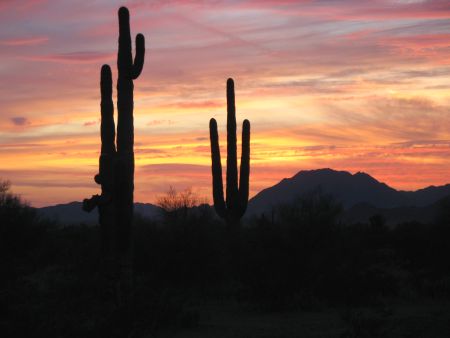 The last sunset of winter! A beautiful evening for a walk.
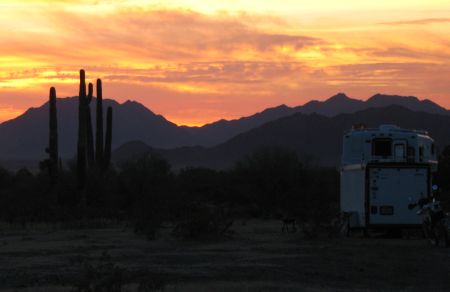 Also, the last night at this campsite. We move tomorrow to explore another area in the Kofa Nat’l. Wildlife Refuge.

The last sunset of winter! A beautiful evening for a walk.
Also, the last night at this campsite. We move tomorrow to explore another area in the Kofa Nat’l. Wildlife Refuge.
Kofa is home to a grove of California fan palms, with maybe one or two other groves around the state, the only native palms in Arizona. We rode our motorcycles to Palm Canyon then hiked the 1/2 mile trail to the observation point and saw the palms about 1/2 mile up a steep, narrow side canyon. The habitat, although lush looking now with the spring growth from winter rains, seems very forbidding and rocky. Perhaps the narrowness of the canyon is a bonus, shading the trees from the intense sun for most of the day!
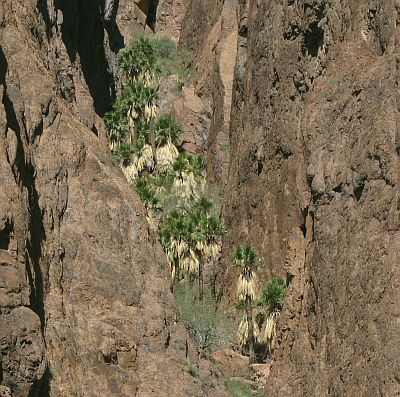
The palms, high up in a side canyon.
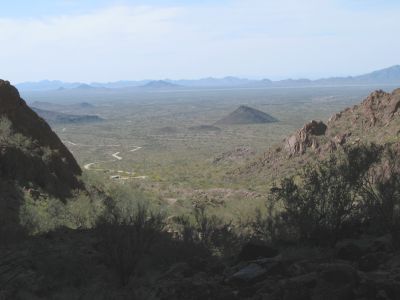
Looking back at the vista from Palm Canyon, the La Paz valley encompassed in the Yuma Proving Ground Military Reservation.
Kofa Nat’l Wildlife Refuge is fully in the Sonoran desert of Arizona, identified mainly by the imposing Saguaro, the ubiquitous cactus of upraised arms in “Roadrunner & Wily Coyote” cartoons and “Arizona Highways” pictures.
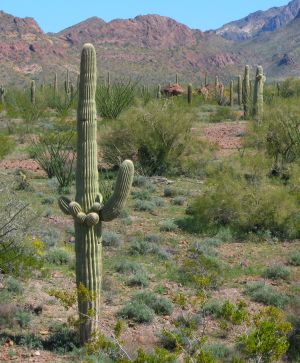 The Saguaro is a fascinating plant. We are here too early in the season to see the flowers which bloom at night, but if you’re interested in more info. click here.
The desert is abloom and the camera cannot capture the vibrant hues. One of the more delicate rose-colored flowers I learned is appropriately called the Fairy Duster.
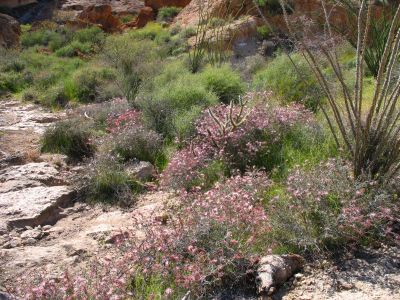
Click on the name above to get a closeup picture and more info. about this flower.
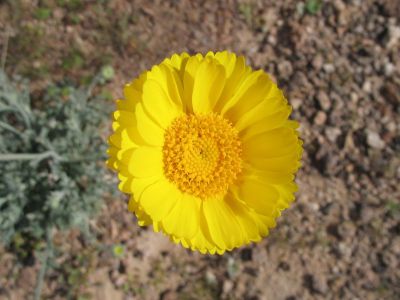
Brittlebush flower.
This single brittlebush flower conveys the beautiful gold, sunshiny color. Now imagine huge bushes with thousands of these flowers covering a dry wash!
We arrived at the Kofa National Wildlife Refuge on March 4 and immediately fell in love with the lonely landscape. This is a huge area of over 660,000 acres set aside in 1939 for the protection of mainly the desert bighorn sheep. With management and enhancement of natural water holes the population of the bighorn sheep has increased to the point that they have ben transplanted throughout Arizona and neighboring states. With rugged one-track 4-wheel drive roads into the Refuge we were able to explore some of these water holes. The fall rains over Thanksgiving have carpeted the desert with green. Gold, red, orange, purple and white flowers are bursts of color that cannot be duplicated in pictures! It is the bighorn sheep calving season so they are high in the mountains and virtually inaccessible, so we haven’t seen them or any sign of them. The birds however are very active, singing even through the night.

Horse tanks in the Castle Dome mountains. The water holes are typically referred to as 'tanks'.

A millenia of intermittent water flow has streaked this rock. Most water holes are a series of depressions in a natural water flow pattern. The Fish & Wildlife Dept. has dammed some of the flow to enlarge the water holes and increase the availability and reliability of water in this desert landscape.